
Connecticut Legislative Updates - 2026 Session
Prepared for Central Connecticut Chambers of Commerce Members
By Donna Carroccia and Liz Gemski, Kozak & Salina
The Connecticut General Assembly convened its 2026 session in early February and lawmakers have moved quickly on several issues with direct implications for employers and the regional economy. Much of the early conversation at the Capitol is centered around affordability, workforce competitiveness, healthcare costs, and energy prices. Below is a brief overview of key developments most relevant to businesses in the Central Connecticut region.
Updates as of April 2, 2026
Action Alert - Support HB 5378 – An Act Concerning Self-Funded Multiple Employer Welfare Arrangements
Refer to the email sent to you today for sample email verbiage and email addresses of the legislative members.
Please contact our elected officials in both the House and Senate urging them to:
- Call the bill for a vote
- Ask for their support
- Co-sponsor House Bill 5378
Updates as of March 9, 2026
Action Alert - Support HB 5378 – An Act Concerning Self-Funded Multiple Employer Welfare Arrangements
Insurance & Real Estate Committee Preparing to Take Final Action
The Insurance & Real Estate Committee will soon be taking final committee action on HB 5378 – An Act Concerning Self-Funded Multiple Employer Welfare Arrangements.
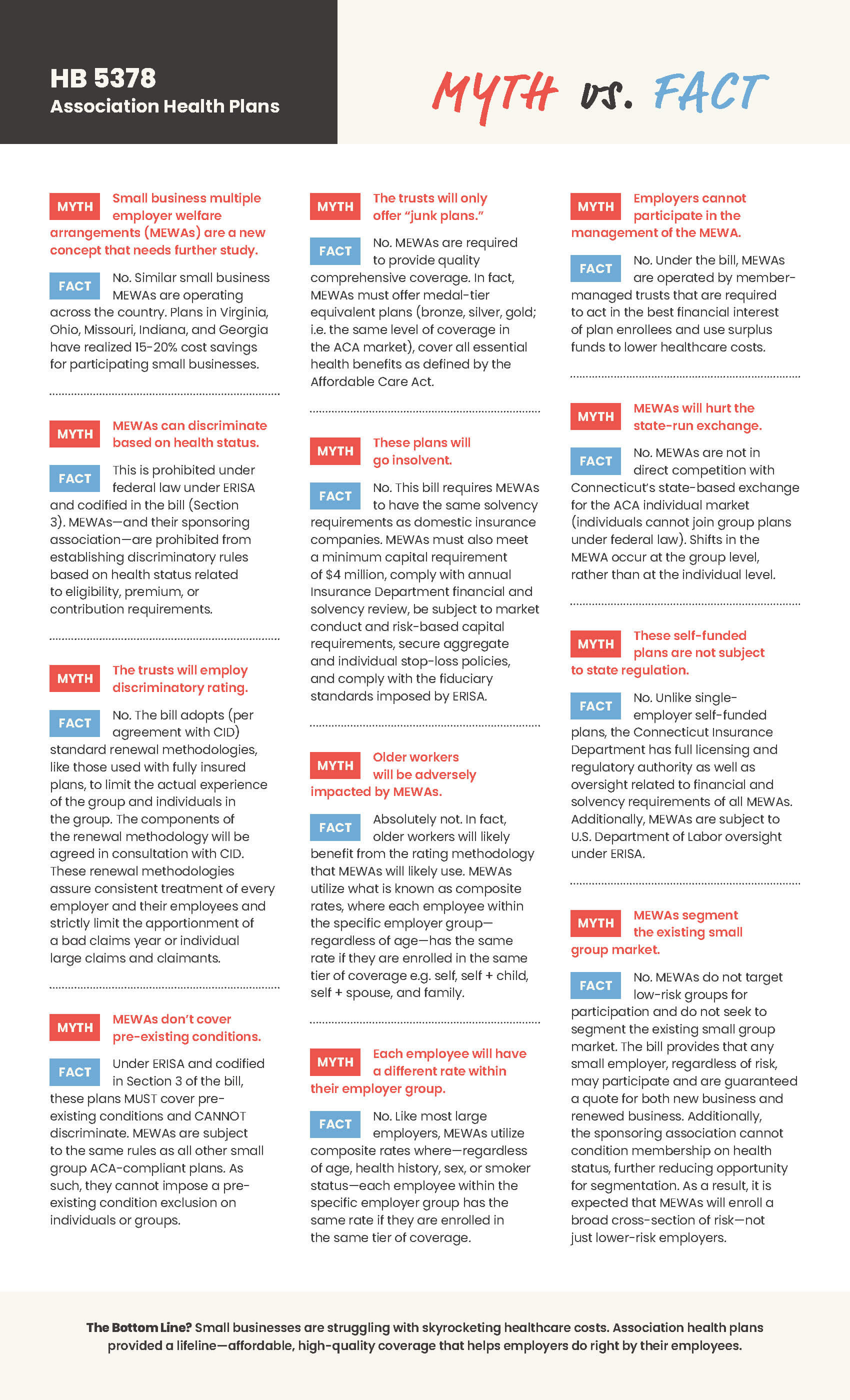
This legislation would allow qualified trade associations and organizations such as chambers of commerce to establish association health plans.
For many small businesses, health insurance remains one of the most challenging and unpredictable costs of doing business. Rising premiums and limited flexibility in the small group market continue to make it difficult for employers to offer competitive benefit packages.
HB 5378 creates a structured and regulated framework that allows employers to pool together through a sponsoring association and participate in a licensed employee health benefit consortium.
The bill includes important safeguards, including:
- Oversight and licensure by the Connecticut Insurance Department
- Required capital and solvency standards
- Mandatory stop-loss protections
- Prohibitions on preexisting condition exclusions and discrimination based on health status
- Required consumer disclosures and regulatory reporting
For small employers, this legislation provides a responsible pathway to increase access to affordable health coverage while maintaining strong consumer protections.
Chamber Members: Your Voice Matters
As the committee prepares to take final action, legislators need to hear directly from employers about how health insurance costs impact their businesses and their employees.
We encourage members to contact Insurance & Real Estate Committee members and ask them to support HB 5378. Even a short email explaining how rising health care costs affect your business can make a meaningful difference.
Refer to the email sent to you today for sample email verbiage and email addresses of the committee members.
Updates as of March 6, 2026
Healthcare & Employer Benefits
Healthcare affordability remains a central topic this session.
The Insurance and Real Estate Committee is again considering legislation that would allow Association Health Plans (AHPs), enabling chambers of commerce and trade associations to pool employers together to offer health coverage (HB 5378). This concept is aimed at giving small businesses greater purchasing power and plan design flexibility.
As noted in testimony submitted this week by Central Connecticut Chambers President & CEO Katie D’Agostino, small employers currently face limited market competition and rising costs, with only a small number of carriers offering plans in the small group market. The proposal would allow employers to collectively participate in a self-funded health trust with strong regulatory oversight and reserve requirements.
If enacted, this policy could help employers access more stable pricing, increased plan options, and greater control over long-term health benefit costs, which has been one of the most frequently cited challenges by chamber members.
Separately, the state is also exploring longer-term healthcare affordability strategies, including a potential “Connecticut Option” style public plan concept, though current discussion is focused primarily on feasibility and study.
Energy & Electric Costs
Electric costs remain one of the most visible economic concerns at the Capitol.
Lawmakers in both parties have introduced proposals aimed at reducing or restructuring the Public Benefits Charge on electric bills, which funds various state energy programs but has become a focal point for affordability concerns.
Other proposals being discussed include expanding municipal electric aggregation, which could allow communities to pool purchasing power to negotiate electricity supply contracts. While still early in the legislative process, these discussions reflect growing pressure to address energy prices for both households and employers.
Artificial Intelligence & Technology Policy
Connecticut is also beginning to shape its approach to artificial intelligence regulation and innovation.
The Governor has introduced legislation addressing responsible use of AI systems, including transparency and consumer protections for emerging technologies such as AI chatbots and automated decision tools.
At the same time, the administration is pairing these guardrails with workforce and education initiatives aimed at expanding AI and technology training programs in Connecticut’s colleges and workforce development pipeline.
The goal expressed by policymakers is to position Connecticut as both a responsible regulator and a competitive technology hub.
Workforce & Employment Policy
Workforce development continues to be a major theme across several policy areas.
Proposals this year include:
- Expanding apprenticeship incentives and workforce training programs
- Additional wage transparency requirements for job postings
- Continued efforts to strengthen the education-to-career pipeline
From a business perspective, many of these discussions are framed around the need to help employers recruit and retain talent in a tight labor market, while balancing new compliance requirements.